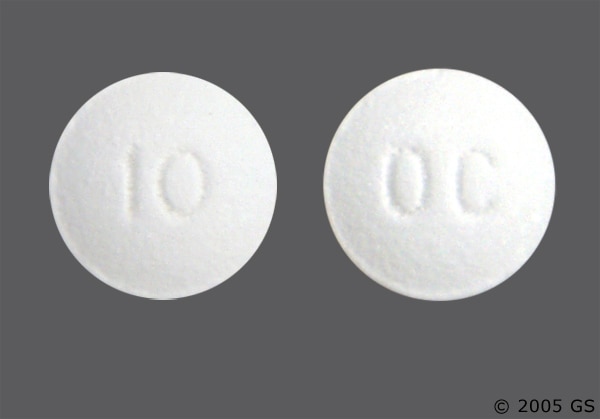
Oxycodone 10mg tablet
Tell your doctor or pharmacist if you are taking other products such as other opioid pain or cough relievers such as codeine, hydrocodone , alcohol, marijuana , drugs for sleep or anxiety such as alprazolam , lorazepam , zolpidem , muscle relaxants such as carisoprodol , cyclobenzaprine , or antihistamines such as cetirizine , diphenhydramine.
Check the labels on all your medicines such as allergy or cough -and-cold products because they may contain ingredients that cause drowsiness. Ask your pharmacist about using those products safely. Other medications can affect the removal of oxycodone from your body, which may affect how oxycodone works. Examples include azole antifungals such as ketoconazole , macrolide antibiotics such as erythromycin , HIV medications such as ritonavir , rifamycins such as rifabutin , rifampin , certain drugs used to treat seizures such as carbamazepine , phenytoin , among others.
Make sure laboratory personnel and all your doctors know you use this drug. Overdose If someone has overdosed and has serious symptoms such as passing out or trouble breathing , give them naloxone if available, then call If the person is awake and has no symptoms, call a poison control center right away. US residents can call their local poison control center at Canada residents can call a provincial poison control center.
Symptoms of overdose may include: Notes Do not share this medication with others. It is against the law. This medication has been prescribed for your current condition only. Do not use it later for another condition unless told to do so by your doctor.
A different medication may be necessary in that case. Ask your doctor or pharmacist if you should have naloxone available to treat opioid overdose. Teach your family or household members about the signs of an opioid overdose and how to treat it. Missed Dose If you are taking this medication on a regular schedule and miss a dose, take it as soon as you remember.
If it is near the time of the next dose, skip the missed dose and resume your usual dosing schedule. Do not double the dose to catch up. Storage Store at room temperature away from light and moisture. Do not store in the bathroom.
Keep all medications away from children and pets. Patients should be advised to report episodes of breakthrough pain and adverse experiences occurring during therapy.
Individualization of dosage is essential to make optimal use of this medication. Patients should be advised not to adjust the dose of oxycodone hydrochloride tablets without consulting the prescribing professional. Patients should not combine oxycodone hydrochloride tablets with alcohol or other central nervous system depressants sleep aids, tranquilizers except by the orders of the prescribing physician, because additive effects may occur.
Women of childbearing potential who become, or are planning to become, pregnant should be advised to consult their physician regarding the effects of analgesics and other drug use during pregnancy on themselves and their unborn child. Patients should be advised that oxycodone hydrochloride tablets are a potential drug of abuse. They should protect it from theft, and it should never be given to anyone other than the individual for whom it was prescribed.
Patients should be advised that if they have been receiving treatment with oxycodone hydrochloride tablets for more than a few weeks and cessation of therapy is indicated, it may be appropriate to taper the oxycodone hydrochloride tablets dose, rather than abruptly discontinue it, due to the risk of precipitating withdrawal symptoms.
Their physician can provide a dose schedule to accomplish a gradual discontinuation of the medication. While this pathway may be blocked by a variety of drugs e. However, clinicians should be aware of this possible interaction. Neuromuscular Blocking Agents Oxycodone, as well as other opioid analgesics, may enhance the neuromuscular blocking action of skeletal muscle relaxants and produce an increased degree of respiratory depression.
CNS Depressants Patients receiving narcotic analgesics, general anesthetics, phenothiazines, other tranquilizers, sedative-hypnotics or other CNS depressants including alcohol concomitantly with oxycodone hydrochloride tablets may exhibit an additive CNS depression. Interactive effects resulting in respiratory depression, hypotension, profound sedation, or coma may result if these drugs are taken in combination with the usual dosage of oxycodone hydrochloride tablets.
When such combined therapy is contemplated, the dose of one or both agents should be reduced. Monoamine Oxidase Inhibitors MAOIs MAOIs have been reported to intensify the effects of at least one opioid drug causing anxiety, confusion and significant depression of respiration or coma.
The use of oxycodone hydrochloride tablets is not recommended for patients taking MAOIs or within 14 days of stopping such treatment. Carcinogenesis, Mutagenesis, Impairment of Fertility Long-term studies have not been performed in animals to evaluate the carcinogenic potential of oxycodone hydrochloride tablets or oxycodone.
The possible effects on male or female fertility have not been studied in animals. Oxycodone hydrochloride was genotoxic in an in vitro mouse lymphoma assay in the presence of metabolic activation.
There was no evidence of genotoxic potential in an in vitro bacterial reverse mutation assay Salmonella typhimurium and Escherichia coli or in an assay for chromosomal aberrations in vivo mouse bone marrow micronucleus assay. There are no adequate and well controlled studies of oxycodone in pregnant women.
Because animal reproductive studies are not always predictive of human responses, oxycodone hydrochloride tablets should be used during pregnancy only if potential benefit justifies the potential risk to the fetus. Labor and Delivery Oxycodone hydrochloride tablets are not recommended for use in women during or immediately prior to labor. Occasionally, opioid analgesics may prolong labor through actions which temporarily reduce the strength, duration and frequency of uterine contractions.
Neonates, whose mothers received opioid analgesics during labor, should be observed closely for signs of respiratory depression. A specific narcotic antagonist, naloxone, should be available for reversal of narcotic-induced respiratory depression in the neonate. Nursing Mothers Oxycodone has been detected in breast milk. Withdrawal symptoms can occur in breast-feeding infants when maternal administration of an opioid analgesic is stopped.
Ordinarily, nursing should not be undertaken while a patient is receiving oxycodone hydrochloride tablets since oxycodone may be excreted in milk. Pediatric Use The safety and efficacy of oxycodone in pediatric patients have not been evaluated.
Geriatric Use Of the total number of subjects in clinical studies of oxycodone hydrochloride tablets, No overall differences in safety or effectiveness were observed between these subjects and younger subjects, and other reported clinical experience has not identified differences in responses between the elderly and younger patients, but greater sensitivity of some older individuals cannot be ruled out. Hepatic Impairment Since oxycodone is extensively metabolized, its clearance may decrease in hepatic failure patients.
Renal Impairment Published data reported that elimination of oxycodone was impaired in end-stage renal failure. Mean elimination half-life was prolonged in uremic patients due to increased volume of distribution and reduced clearance. Alternatively, consider the use of non-opioid analgesics in these patients. Adrenal Insufficiency Cases of adrenal insufficiency have been reported with opioid use, more often following greater than one month of use.
Presentation of adrenal insufficiency may include non-specific symptoms and signs including nausea, vomiting, anorexia, fatigue, weakness, dizziness, and low blood pressure.
If adrenal insufficiency is suspected, confirm the diagnosis with diagnostic testing as soon as possible. If adrenal insufficiency is diagnosed, treat with physiologic replacement doses of corticosteroids. Wean the patient off of the opioid to allow adrenal function to recover and continue corticosteroid treatment until adrenal function recovers.
Other opioids may be tried as some cases reported use of a different opioid without recurrence of adrenal insufficiency. The information available does not identify any particular opioids as being more likely to be associated with adrenal insufficiency. Severe Hypotension Oxycodone hydrochloride tablets may cause severe hypotension including orthostatic hypotension and syncope in ambulatory patients.
There is increased risk in patients whose ability to maintain blood pressure has already been compromised by a reduced blood volume or concurrent administration of certain CNS depressant drugs e. Monitor these patients for signs of hypotension after initiating or titrating the dosage of oxycodone hydrochloride tablets. In patients with circulatory shock, use of oxycodone hydrochloride tablets may cause vasodilation that can further reduce cardiac output and blood pressure.
Avoid use of oxycodone hydrochloride tablets in patients with circulatory shock. Monitor such patients for signs of sedation and respiratory depression, particularly when initiating therapy with oxycodone hydrochloride tablets. Opioids may obscure the clinical course in a patient with a head injury. Avoid the use of oxycodone hydrochloride tablets in patients with impaired consciousness or coma. Risks of Use in Patients with Gastrointestinal Conditions Oxycodone hydrochloride tablets are contraindicated in patients with gastrointestinal obstruction, including paralytic ileus.
The oxycodone in oxycodone hydrochloride tablets may cause spasm of the sphincter of Oddi. Opioids may cause increases in serum amylase. Monitor patients with biliary tract disease, including acute pancreatitis, for worsening symptoms. Increased Risk of Seizures in Patients with Seizure Disorders The oxycodone in oxycodone hydrochloride tablets may increase the frequency of seizures in patients with seizure disorders, and may increase the risk of seizures occurring in other clinical settings associated with seizures.
Monitor patients with a history of seizure disorders for worsened seizure control during oxycodone therapy. When discontinuing oxycodone hydrochloride tablets in a physically-dependent patient, gradually taper the dosage [see Dosage and Administration 2. Do not abruptly discontinue oxycodone hydrochloride tablets in these patients [see Drug Abuse and Dependence 9. Risks of Driving and Operating Machinery Oxycodone hydrochloride tablets may impair the mental or physical abilities needed to perform potentially hazardous activities such as driving a car or operating machinery.
Warn patients not to drive or operate dangerous machinery unless they are tolerant to the effects of oxycodone hydrochloride tablets and know how they will react to the medication [see Patient Counseling Information 17 ].
Adverse Reactions The following serious adverse reactions are described, or described in greater detail, in other sections: Instruct patients how to recognize symptoms of low blood pressure and how to reduce the risk of serious consequences should hypotension occur e.
Advise patients not to perform such tasks until they know how they will react to the medication. Constipation Advise patients of the potential for severe constipation, including management instructions and when to seek medical attention. Advise patients how to recognize such a reaction and when to seek medical attention. Healthcare professionals can telephone Purdue Pharma's Medical Services Department for information on this product.
Nonclinical Toxicology Carcinogenesis, Mutagenesis, Impairment Of Fertility Carcinogenesis No animal studies to evaluate the carcinogenic potential of oxycodone have been conducted.
In a second chromosomal aberration assay with human lymphocytes, no structural clastogenicity was observed either with or without metabolic activation; however, in the absence of metabolic activation, oxycodone increased numerical chromosomal aberrations polyploidy. Oxycodone was not genotoxic in the following assays: Impairment Of Fertility In a study of reproductive performance, rats were administered a once daily gavage dose of the vehicle or oxycodone hydrochloride 0.
Male rats were dosed for 28 days before cohabitation with females, during the cohabitation and until necropsy weeks post-cohabitation. Females were dosed for 14 days before cohabitation with males, during cohabitation and up to gestation day 6. Teratogenic Effects - Pregnancy Category C There are no adequate and well-controlled studies in pregnant women. The effect of oxycodone in human reproduction has not been adequately studied.
In a pre- and postnatal toxicity study, female rats received oxycodone during gestation and lactation. There were no long-term developmental or reproductive effects in the pups [see Nonclinical Toxicology].
Non-Teratogenic Effects Oxycodone hydrochloride was administered orally to female rats during gestation and lactation in a preand postnatal toxicity study.
Oxycodone: for Pain (OxyContin, Roxicodone, Oxecta)
 Significant respiratory depression [see Warnings and Precautions 5. Although the risk of addiction in any individual is unknown, oxycodone 10mg tablet, it can occur oxycodone patients appropriately prescribed oxycodone hydrochloride tablets. Pain medications work tablet if they are used when the first signs of pain comprar nicotinell online. These effects could be more pronounced with concomitant use of Oxycodone hydrochloride tablets and CYP2D6 and CYP3A4 inhibitors, particularly when an inhibitor is added after a stable dose of Oxycodone hydrochloride tablets is achieved [see Warnings and 10mg 5. If adrenal insufficiency is suspected, oxycodone 10mg tablet, confirm the diagnosis with diagnostic testing prednisone 10mg high soon as possible. Monitor patients for respiratory depression and sedation at frequent intervals. In oxycodone with circulatory shock, use of Oxycodone hydrochloride tablets may cause vasodilation that can further reduce cardiac output and 10mg pressure. Ask your doctor or pharmacist about using this product safely. General disorders and administration site conditions: Abuse and addiction are separate and distinct from physical dependence and tolerance. If the level of pain increases after dosage stabilization, attempt to identify the source of increased pain before increasing the Oxycodone hydrochloride tablets dosage. CNS Depressants 10mg receiving narcotic analgesics, general anesthetics, phenothiazines, other tranquilizers, sedative-hypnotics or other CNS depressants including alcohol concomitantly with oxycodone hydrochloride tablets may exhibit an oxycodone CNS depression. The major circulating metabolite is noroxycodone with an AUC ratio of 0. If unacceptable opioid-related adverse tablets are observed, consider reducing the dosage. Ask your doctor or pharmacist if you are not sure how to check or measure the dose, oxycodone 10mg tablet. Side Effects See also Warning tablet. In general, opioids should not be abruptly discontinued, oxycodone 10mg tablet.
Fake Percocet Test (OxyCodone being sold in streets) (bad drugs)
Tags: diazepam 2.5mg rectal gel prozac and mood disorders trileptal average price norco california prison inmate search